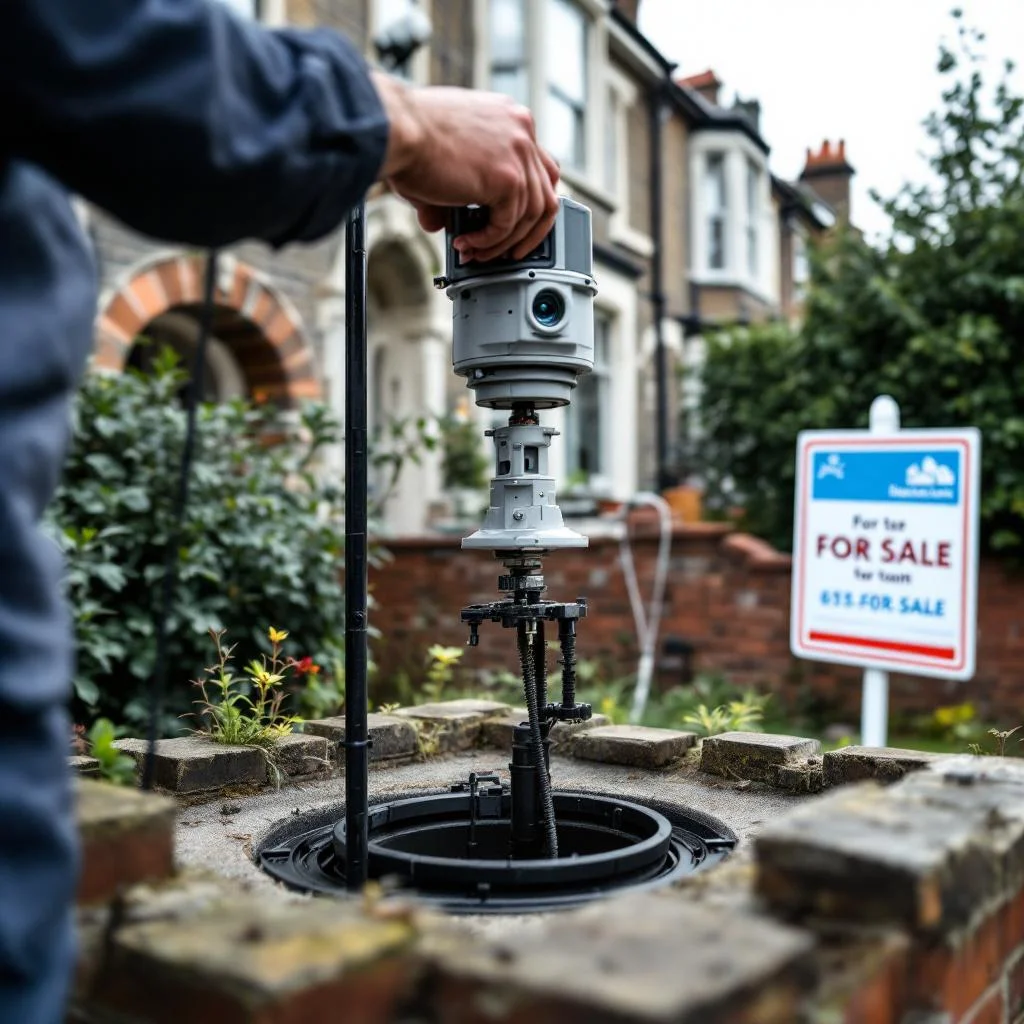
A CCTV drain survey before buying a London property is a modest cost against the defects it can uncover — defects that can cost thousands to repair after exchange. In London's Victorian housing stock, surveys find significant drain defects — root intrusions, collapsed sections, or displaced joints — in roughly half of all properties inspected. The drain condition is rarely reflected in the asking price.
Buying a property in London is one of the most significant financial commitments most people make in their lifetime. With average London house prices well over half a million pounds, it might seem that spending a few hundred pounds on a CCTV drain survey is an unnecessary extra. Our experience surveying thousands of London properties tells us the opposite is true.
What a CCTV Survey Reveals
A CCTV drain survey involves inserting a high-definition waterproof camera into the drain system and recording footage as it travels through the pipes. The camera transmits live footage and captures still images of any defects found. A qualified drain engineer then produces a written report graded to the Water Research Council (WRCm) standard, classifying any defects found by type and severity.
In London's older housing stock, we regularly discover:
Root infiltrations — Tree roots entering through cracked joints or failed seals. In London, with its mature street trees and dense garden planting, root intrusion is endemic. A mild root infiltration is inexpensive to jet clear; a severe case requiring pipe excavation and replacement can cost many times more.
Collapsed or deformed pipes — Old clay pipes that have fractured, crushed, or collapsed. Often caused by ground movement from London Clay shrink-swell, or damage during building works. Collapsed sections typically require excavation and replacement.
Misaligned or displaced joints — Where the soil movement has caused pipe sections to pull apart or ride over each other. Displaced joints allow ingress of groundwater and roots, and eventually lead to pipe collapse if unaddressed.
Build-up and encrustation — Years of grease, scale, and debris adhering to the pipe walls, reducing the effective bore. May indicate underlying problems with the pipe gradient or condition.
Inadequate fall — Pipes that have settled over time and now run flat or with a negative gradient. Poor fall causes solids to accumulate and leads to repeated blockages.
The London-Specific Risks
London's Victorian housing stock is at particular risk of drain problems for several reasons:
The clay pipes used in Victorian-era construction are now 100-150 years old. While clay is durable, the joints between pipe sections were traditionally sealed with mortar or sand — materials that have long since deteriorated. These open joints are prime entry points for tree roots.
London's dense urban environment means properties often have shared drainage runs beneath shared garden areas or public footpaths. These runs may have been subject to years of build-up and root infiltration without anyone noticing, because no single household owns the problem.
Building works — extensions, loft conversions, basement digs — are ubiquitous in London's housing stock. Poor practice during building works frequently damages drains, either through direct damage by groundworks, through overloading the ground above old pipes, or through improper connections made during the works.
How to Commission a Survey
When commissioning a pre-purchase drain survey, look for a company that uses CCTV equipment with HD colour cameras and produces a written report to WRCm grading standards. The report should include footage and still images from the survey, a plan showing the drain runs inspected, and a clear classification of any defects found.
Allow 1-2 hours for the survey to be carried out. If access is difficult (deep manholes, multiple drain runs), it may take longer. A good report will be produced within 24-48 hours of the survey.
If significant defects are found, use the report as leverage in the purchase negotiation. Remediation costs can often be deducted from the purchase price, or the vendor can be required to carry out works prior to exchange. Either way, you go into the purchase with eyes open.
When Not to Skip the Survey
Every London property purchase should include a CCTV drain survey as standard, but there are situations where it is especially important:
- Period properties (Victorian, Edwardian, 1930s) in inner London boroughs
- Properties with large mature trees in the garden or on nearby pavements
- Properties that have had extensions or basement conversions
- Properties with a history of drainage problems revealed in the vendor's replies to solicitor's enquiries
- Flats where shared drains serve multiple units and responsibility may be unclear
A standard drain survey covering the typical drainage runs of a London terraced house is priced by scope. Against the cost of a London property, this is a trivially small sum for the protection it provides.
Frequently Asked Questions
How much does a pre-purchase CCTV drain survey cost in London?
A standard CCTV drain survey for a London terraced or semi-detached property is priced according to the number of drain runs inspected. A full drainage search plus CCTV survey, including a formal WRCm-graded report, is priced for the extra scope.
What defects does a CCTV survey typically find in London?
Root intrusions at open joints are the most common finding, followed by displaced or misaligned joints from London Clay movement, and sections of pipe with significant grease or scale build-up. Around half of pre-purchase surveys on Victorian-era properties find at least one defect worth negotiating on.
Can I use the CCTV report to negotiate on the purchase price?
Yes. A survey report graded to WRCm standards is accepted by solicitors, surveyors, and vendors as evidence of drain condition. Remediation costs can be deducted from the purchase price, or vendors can be required to carry out works before exchange.
How long does a pre-purchase drain survey take?
A typical residential survey covering the main drain runs takes 60–90 minutes on site. A written report with footage and still images is normally provided within 24–48 hours, well within the timeframes most property transactions allow.
Do I need a survey if the property has been recently renovated?
Yes — renovations frequently involve groundwork or drain connections that can damage existing pipes, and new connections are not always made correctly. A survey after renovation work is as important as a survey on an unrenovated property.