The Elizabeth Line transformed travel across West London, but the decade of Crossrail construction that made it possible also left a complex legacy for the drainage infrastructure in Ealing, Brent, and the surrounding boroughs. We've been attending drainage callouts in these areas since the tunnelling and station work began in the 2010s, and patterns have emerged that homeowners in the affected corridors should understand. Some drain problems in Ealing and Brent are directly attributable to construction disturbance; others are pre-existing issues that construction vibration and dewatering have accelerated.
What Crossrail Construction Did to Local Drainage
The Elizabeth Line's western tunnels run at significant depth — typically 20–40 metres below street level in the Ealing and Acton sections. Tunnel boring machine (TBM) work at this depth has limited direct impact on shallow residential drainage at 1–3 metres depth. The more significant construction impacts on local drainage came from:
Station construction and ground modification. Major station works at Ealing Broadway and associated ground-level works involved significant excavation, dewatering, and ground movement. Dewatering — pumping groundwater out of excavations — can cause settlement in surrounding ground, which applies movement to buried pipes.
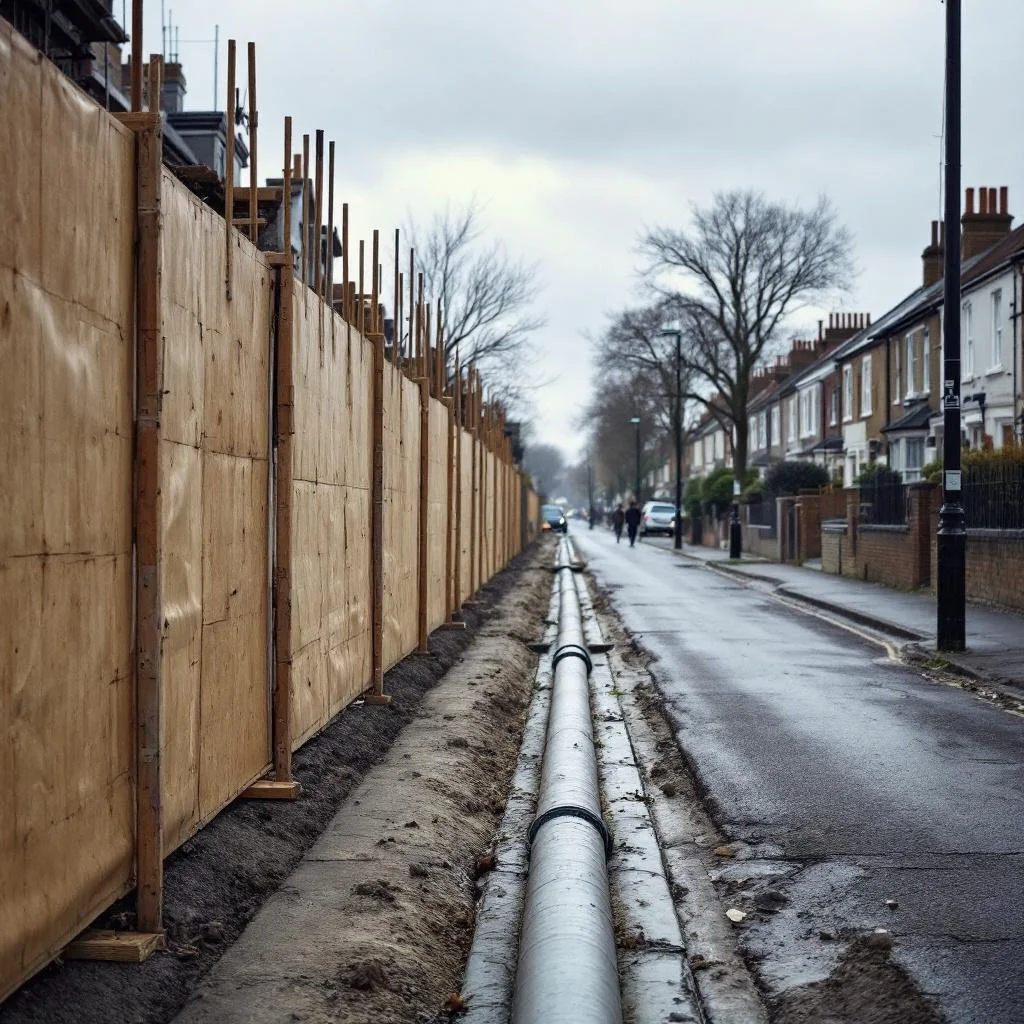
Utility diversions. Crossrail required extensive diversion of utilities along the construction corridor. Contractors rerouted water mains, gas pipes, telecommunications, and drainage to clear the construction zone. Not every diversion met the same standard, and some drainage diversions introduced changes in pipe gradient or new joints that have since proved problematic.
Ground vibration from TBMs and blasting. Tunnel boring, even at depth, generates vibration that propagates through the ground. Old clay pipes with marginal joints are vulnerable to vibration — it can loosen a joint that was previously stable.
Surface disruption and reinstatement quality. Years of construction-related road works left Ealing and Brent streets with multiple rounds of excavation and reinstatement. Where reinstatement was done in multiple layers over an extended period, the ground around shallow drains has experienced repeated disturbance.
What We're Seeing in Ealing and Brent Drains
Our CCTV surveys in the Ealing and Brent corridor over the past three years show consistent patterns:
Displaced joints in Victorian clay. The most common finding. Joints that were previously stable — packed with mineral deposits that effectively sealed them — have been displaced by ground movement, leaving gaps that admit groundwater and root ingress.
New root intrusion through disrupted joints. Once a joint opens even a few millimetres, tree roots exploit the gap rapidly. In the residential streets of Ealing with mature plane and lime trees, we're seeing accelerated root intrusion in pipes that showed no root problems on surveys conducted five years ago.
Gradient changes in diverted runs. Where drainage was diverted to clear construction zones and the new route has a different gradient than the original, we're seeing silt accumulation in sections with reduced gradient. Slow drainage and recurring partial blockages are the result.
Increased groundwater ingress. Ealing and Brent sit on a mix of gravel and London Clay geology. Dewatering during construction affected groundwater levels, and in the recovery phase — as groundwater returns to pre-construction levels — some areas are experiencing higher groundwater ingress into old drainage pipes than they did before construction.
How to Tell if Your Drain Has Been Affected
Symptoms consistent with construction-related drain disruption include:
Recurring blockages without an obvious cause. If a drain that was previously trouble-free has started blocking two or three times per year without any change in usage, the pipe itself may have developed a defect that is catching debris and causing accumulation.
Slow drainage across multiple fixtures. If drainage has slowed in the kitchen and the bathroom simultaneously, and this developed gradually over the past few years, partial root intrusion or silt accumulation in the main lateral is a likely cause.
Wet patches in the garden. Groundwater ingress into a cracked drain can saturate the surrounding soil. If areas of your garden that were previously dry are now persistently wet, and this correlates with wet weather, a cracked pipe allowing ingress (or exfiltration from the drain) is worth investigating.
Drain smells without obvious blockage. Cracked or displaced joints allow sewer gases to escape into the surrounding soil and occasionally into structures. Persistent drain smell in a room above or beside a drain run can indicate a joint defect.
What to Do If You Suspect Disruption-Related Damage
A CCTV survey is the diagnostic tool. If you suspect your drain has been affected by construction activity, a survey conducted by a specialist — with a full written report, distance-referenced defect coding, and a condition grade — gives you both the diagnosis and the documentation needed if you're pursuing a claim.
Documentation matters in construction-related damage claims. A pre-works drain survey (if you had one conducted before construction started) plus a current survey showing new defects is the strongest evidence. If you don't have a pre-works survey, a current survey combined with historical evidence of when drainage problems started can still support a claim.
Our drain repairs service covers the Ealing and Brent corridor, and our CCTV survey service produces reports suitable for use in compensation claims.
Crossrail Compensation Scheme — Drainage Claims
Crossrail Limited operated a compensation and claims scheme during the construction period. For drainage damage attributable to construction works, claims could be submitted to the project's claims team. The main construction period has now concluded, and the scheme for new claims related to construction-period damage has closed for most categories.
However, for claims arising from post-construction settlement — where ground movement continues after construction completion — the position is more complex. Specialist legal advice may be needed for significant drainage claims related to ongoing post-construction settlement.
For smaller-scale repair works — clearing construction-related blockages, relining displaced joints — the most practical approach is simply to carry out the repair, get the drain back in service, and pursue compensation separately if the evidence supports a claim.
Lessons from the Crossrail Decade for HS2 Corridor Homeowners
The pattern of drainage damage we documented across Ealing and Brent during the Crossrail construction decade now offers a practical playbook for homeowners along the HS2 alignment through Brent, Camden, and Ealing's northern fringe. The headline lesson is that the most expensive damage to private drains is rarely caused by the visible surface works — it is the cumulative effect of vibration, dewatering, and post-construction settlement playing out over five to ten years after the contractors leave site.
Three practical steps are worth taking before HS2 works reach your section of West London. First, commission a baseline CCTV survey while construction is still distant — ideally before any preparatory utility diversions begin in your street. The cost is modest and the survey footage is the single most valuable piece of evidence in any future claim. Second, document the surface and structure of your property with dated photographs, including any existing cracks, settlement, or driveway irregularities. Third, register your address on the relevant project's claims database when registration opens — claims teams are far more responsive to claimants who registered before damage became visible.
FAQ
Can I claim against Crossrail for drainage damage?
It depends on when the damage occurred and whether it can be causally linked to construction activity. The main claims period has closed, but specialist construction solicitors can advise on continuing exposure for post-construction settlement claims. Our survey reports can provide the technical evidence needed.
Are drains in Ealing and Brent unusually old?
The residential streets of Ealing and Brent include large areas of Victorian and Edwardian housing with drainage from the same period. 100+ year-old clay pipe is common. Construction vibration accelerates displacement of ageing joints in this type of pipe.
Will new construction around HS2 cause similar problems?
HS2 construction is producing similar drainage concerns along its route. The best protection for homeowners in construction corridors is a CCTV drainage survey before construction starts — so you have a baseline for comparison. Our pre-purchase survey service can be adapted for a pre-construction baseline survey.
How quickly can you attend a drainage issue in Ealing or Brent?
We cover both boroughs with a same-day or next-day survey service, and prioritise urgent jobs for the fastest possible emergency response. Request a quote online via our contact form or visit our Ealing drainage page to arrange.